|
|
|
Revista Iberoamericana Ambiente & Sustentabilidad ISSN: 2697-3510 I e-ISSN: 2697-3529 I
Vol. 9, 2026 DOI: https://doi.org/10.46380/rias.v9.e532 |
|
|
||||
|
|
|
|
|
|||||
|
|
Educación, cultura y comunicación ambiental |
|
|
|||||
|
|
|
|
|
|||||
|
Ecological intelligence and emotional intelligence: A
conceptual convergence analysis. Inteligencia ecológica e inteligencia
emocional: Un análisis de convergencia conceptual. Inteligência ecológica e inteligência emocional: Uma análise de convergência conceitual. |
Christian
Ernesto López-Machín, Esperanza
López-Vázquez Universidad Autónoma
del Estado de Morelos, México christian.lopez.machin@gmail.com Artículo
de revisión Enviado: 23/8/2025 Aprobado: 7/5/2026 Publicado: 8/5/2026
|
|
||||||


ABSTRACT
Although ecological intelligence and emotional intelligence have been studied as independent constructs, their interactions have not yet been systematically explored. In the context of the global ecological crisis, this study aimed to analyze their conceptual convergence through two bibliometric studies in Scopus. Using VOSviewer, cognitive–emotional–behavioral and contextual terms were identified in 91 publications on "ecological intelligence" and in the 100 most-cited publications on "emotional intelligence." The results revealed an explicit convergence in terms such as adaptability, awareness, behavior, decision-making, empathy, regulation, responsibility, social skills, and well-being. These findings describe the intersection between environmental awareness and emotional processes as interconnected dimensions in literature. However, several limitations were identified, including the absence of implicit terms not directly captured by co-occurrence analyses, such as communication, ethics, resilience, education, and teamwork, despite their recognition in both theoretical constructs. The study concluded that consolidating an integrated theoretical framework could advance environmental education and the development of socioemotional competencies in response to contemporary environmental challenges.
Keywords: emotional
development, environmental education, human ecology, psychology.
RESUMEN
La inteligencia ecológica y la inteligencia emocional han sido estudiadas
como constructos independientes, pero sus interacciones aún no han sido
exploradas de manera sistemática. Ante la crisis ecológica global, este estudio
tuvo como objetivo analizar su convergencia conceptual mediante dos estudios
bibliométricos en Scopus. Mediante VOSviewer, se identificaron términos cognitivo-emocional-conductuales
y contextuales en 91 publicaciones sobre “inteligencia ecológica” y en las 100
publicaciones más citadas sobre “inteligencia emocional”. Los resultados
mostraron una convergencia explícita en términos como adaptabilidad, conciencia,
comportamiento, toma de decisiones, empatía, regulación,
responsabilidad, habilidades sociales y bienestar. Estos
hallazgos describen la intersección entre la conciencia ambiental y los
procesos emocionales como dimensiones interrelacionadas en la literatura. Sin
embargo, se identificaron varias limitaciones, entre ellas la ausencia de
términos implícitos no capturados directamente por los análisis de
coocurrencia, como comunicación, ética, resiliencia, educación
y trabajo en equipo, pese a estar reconocidos en ambos constructos
teóricos. Se concluyó que la consolidación de un marco teórico integrado podría
favorecer avances en educación ambiental y en el desarrollo de competencias
socioemocionales frente a los desafíos ambientales contemporáneos.
Palabras clave: desarrollo emocional,
ecología humana, educación ambiental, psicología.
RESUMO
A inteligência ecológica e a inteligência emocional têm sido estudadas como
construtos independentes, mas suas interações ainda não foram exploradas de
forma sistemática. Diante da crise ecológica global, este estudo teve como
objetivo analisar sua convergência conceitual por meio de dois estudos
bibliométricos na base Scopus. Por meio do VOSviewer,
foram identificados termos cognitivo-emocional-comportamentais e contextuais em
91 publicações sobre "inteligência ecológica" e nas 100 publicações
mais citadas sobre "inteligência emocional". Os resultados mostraram
uma convergência explícita em termos como adaptabilidade, consciência,
comportamento, tomada de decisão, empatia, regulação,
responsabilidade, habilidades sociais e bem-estar. Esses achados
descrevem a interseção entre a consciência ambiental e os processos emocionais
como dimensões inter-relacionadas na literatura. No entanto, foram
identificadas várias limitações, entre elas a ausência de termos implícitos não
capturados diretamente pelas análises de coocorrência,
como comunicação, ética, resiliência, educação e trabalho
em equipe, embora sejam reconhecidos em ambos os construtos teóricos.
Concluiu-se que a consolidação de um marco teórico integrado pode favorecer
avanços na educação ambiental e no desenvolvimento de competências
socioemocionais diante dos desafios ambientais contemporâneos.
Palavras-chave: desenvolvimento
emocional, ecologia humana, educação ambiental, psicologia.
INTRODUCTION
In the context of the global ecological crisis, developing adaptive skills to manage human emotions and relationships with the environment is urgent. Ecological intelligence, defined as the capacity to recognize and reduce the effects of human activities (Goleman, 2009), underscores the connection between environmental awareness and responsible behavior. Recent analyses have reinforced the contemporary relevance of this concept, emphasizing its potential to inform sustainable decision-making and educational practices (Fernández-Dávila, 2023; Pérez-Frausto & Torres-Cantú, 2024; Sterling, 2009). The construct's theoretical foundations date back to Lovelock's Gaia theory (Lovelock, 1979) and are supported by authors such as Shiva (2005) and Orr (1994), who emphasize the connection between human and ecological well-being. More recent work suggests that cultivating ecological awareness contributes to the development of environmental attitudes from early stages of development (Pérez-Frómeta et al., 2023) and to emotionally grounded forms of environmental engagement (Goleman et al., 2012).
Meanwhile, Salovey & Mayer (1990) defined emotional intelligence as the ability to perceive, understand, and regulate emotions. This concept has evolved to include social, educational, and organizational contexts (Bar-On, 1997; Goleman, 1995). Later models, such as Bisquerra (2020), have organized its teaching into dimensions that include emotional awareness, autonomy, regulation, social competencies, and well-being. Current research shows that emotional intelligence is associated with pro-environmental attitudes and behaviors, either directly or through mediating variables such as empathy, climate change perception, and sustainability-related knowledge (Lisboa et al., 2024; Marchetti et al., 2024; Rada et al., 2025; Ballarotto et al., 2025). Additional evidence suggests that positive and self-transcendent emotions, such as awe, gratitude, and compassion, can encourage climate-related engagement and pro-environmental behavior (Schneider et al., 2021; Zelenski & Desrochers, 2021; Shipley & Van Riper, 2022). Conversely, climate-related emotions, including worry, anxiety, and grief, are linked to both environmental action and psychological well-being (Clayton & Ogunbode, 2023; Ogunbode et al., 2022; Ojala et al., 2021; Zeier & Wessa, 2024).
Although these constructs have traditionally been studied separately, their conceptual convergence warrants examination. Ecological intelligence emphasizes sustainable awareness and action, whereas emotional intelligence addresses affective regulation and social interaction. Nevertheless, both constructs share key terms such as awareness, self-regulation, decision-making, and responsibility (Goleman, 2009; Goleman et al., 2012).
Accordingly, the guiding research question was as follows: How do ecological intelligence and emotional intelligence converge conceptually in scientific literature?
The aim of this study was to analyze this convergence by identifying cognitive, behavioral, and affective terms widely recognized in psychological theory (Beck, 2021; Dryden, 2021) and examining their intersections through two co-occurrence-based bibliometric studies in Scopus.
MATERIALS AND METHODS
Two bibliometric analyses were performed to achieve this using Scopus as the source database. VOSviewer (version 1.6.20; Van Eck & Waltman, 2010) was used for a co-occurrence analysis of terms. Co-occurrence methods are widely used in bibliometric research because they identify semantic structures within scientific fields by mapping how often terms appear together in documents (Van Eck & Waltman, 2010). This logic is based on the linguistic principle that the meaning of a term is determined by the terms with which it is associated (Firth, 1957) and on cognitive approaches to semantic networks, which conceptualize knowledge as patterns of associations (Schvaneveldt, 1990).
Ecological intelligence dataset
The first analysis focused on the term "ecological intelligence." On April 28, 2025, a search was conducted using the query string TITLE-ABS-KEY ("ecological intelligence"), with no restrictions on year, language, or document type and with duplicate records removed. A total of 91 publications were retrieved. The full counting method was applied with a minimum threshold of two co-occurrences. The visualization parameters were set to attraction 10, repulsion 0, and scale 1.28. The co-occurrence matrix generated by VOSviewer was exported for subsequent analysis.
Emotional intelligence dataset
The second analysis examined the term "emotional intelligence," using the same search procedure and the query string TITLE-ABS-KEY ("emotional intelligence"). This search yielded 18,654 publications. To maintain comparability with the ecological intelligence dataset and capture the field's core concepts, the 100 most-cited publications were selected for analysis. This criterion is often used in bibliometric studies because highly cited works tend to represent foundational and influential contributions in a scientific field. Classic bibliometric research has shown that citation counts reliably identify the intellectual core of a field (De Solla, 1976; Garfield, 1972). Subsequent developments in citation and co-citation analysis have demonstrated that influential documents play a central role in delineating the conceptual structure of scientific disciplines (Donthu et al., 2021; Small, 1973). Although citation-based selection involves inherent biases, such as favoring older or more established publications, it remains one of the most widely accepted approaches for identifying representative, high-impact literature in large bibliometric datasets.
Selection of terms
After generating the co-occurrence matrices for both datasets in VOSviewer, we subjected the extracted terms to a semantic purification process to ensure analytical relevance (Donthu et al., 2021). The selection focused on terms conceptually related to psychological processes relevant to the comparison between ecological intelligence and emotional intelligence.
Rather than assigning each term to a single psychological dimension, the analysis adopted a broader conceptual framework encompassing cognitive, behavioral, and affective processes. This framework reflects the well-established interdependence of cognition, emotion, and behavior in psychological theory (Beck, 2021; Dryden, 2021). Within this framework, three reference domains were considered for interpretive purposes:
a) cognitive processes, associated with knowledge, understanding, perception, appraisal, and decision-making;
b) behavioral processes, associated with practices, habits, observable actions, and competencies for interaction or environmental engagement;
c) affective processes, associated with emotions, attitudes, values, motivations, and socioemotional dispositions.
Because many constructs involve all three domains simultaneously, the terms were interpreted collectively as cognitive–behavioral–affective psychological processes rather than assigned to mutually exclusive categories.
Additionally, a second analytical group of contextual terms was defined, comprising descriptors that refer to the thematic, disciplinary, or environmental contexts of the constructs (e.g., sustainability, education, ethics).
Terms that did not meet these conceptual criteria were excluded during the purification process. These included bibliographic descriptors referring to publication formats or metadiscursive elements (e.g., article, paper, or review); methodological descriptors referring to research procedures, analytical approaches, or theoretical discussions (e.g., analysis, method, or theory); and generic descriptors consisting of broad, unspecific terms (e.g., people, students, or participants).
The identification of relevant terms followed a structured three-stage procedure.
1. First, we examined each term extracted by VOSviewer semantically, considering its lexical form and co-occurrence relationships within the dataset.
2. Second, the terms were evaluated to determine if they represented cognitive, behavioral, or affective psychological processes or if they were contextual descriptors.
3. Third, the resulting classifications were reviewed to verify conceptual coherence and identify potential category overlaps.
To strengthen procedural transparency and internal consistency, the classification was reviewed in three successive rounds by the first author and in a fourth round by the second author, who applied the same operational criteria throughout. Discrepancies in the interpretation of terms were discussed until consensus was reached on the final classification. A codebook containing operational definitions, inclusion criteria, and representative examples for each analytical category was developed to guide the classification process and facilitate the replicability of the procedure. This codebook is provided as supplementary material (Anexo1).
Comparative analysis and methodological limitations
A Venn diagram was constructed to compare the terms identified in both maps and to visualize their conceptual intersections. For comparative purposes, equivalent terms were unified through minimal lexical normalization rules, including singular–plural merging, integration of close morphological variants, and consolidation of evident semantic equivalents documented in the literature (e.g., “environmental behavior” and “pro-environmental behavior”). This normalization was applied only in cases of explicit equivalence and did not involve free conceptual reinterpretation.
Finally, some methodological limitations should be considered. Although Scopus provides high-quality, peer-reviewed, and internationally indexed literature, the analysis depended on its coverage, which tends to prioritize English-language and journal publications. Co-occurrence analyses also capture only explicit terms in titles, abstracts, and keywords, potentially omitting conceptually relevant but implicit constructs. These constraints define the scope of the findings and should be considered when interpreting the results.
RESULTS
Terms of Ecological Intelligence
As part of the objective of characterizing the semantic structure of ecological intelligence, the analysis of 91 publications generated a map of 65 items and 210 links, with a total link strength of 241 and 12 clusters (figure 1). The most central terms were ecological intelligence (occurrences = 32, links = 45, TLS = 60, Cluster 7), cognition (occurrences = 8, links = 17, TLS = 24, Cluster 1), sustainability (occurrences = 8, links = 22, TLS = 31, Cluster 8), sustainable development (occurrences = 7, links = 25, TLS = 34, Cluster 2), and education (occurrences = 4, links = 18, TLS = 21, Cluster 5).
These clusters emphasized educational practices, behavioral change, and sustainability as key aspects of ecological intelligence.
Figure 1. Co-occurrence map of terms in the studies analyzed on “ecological intelligence”
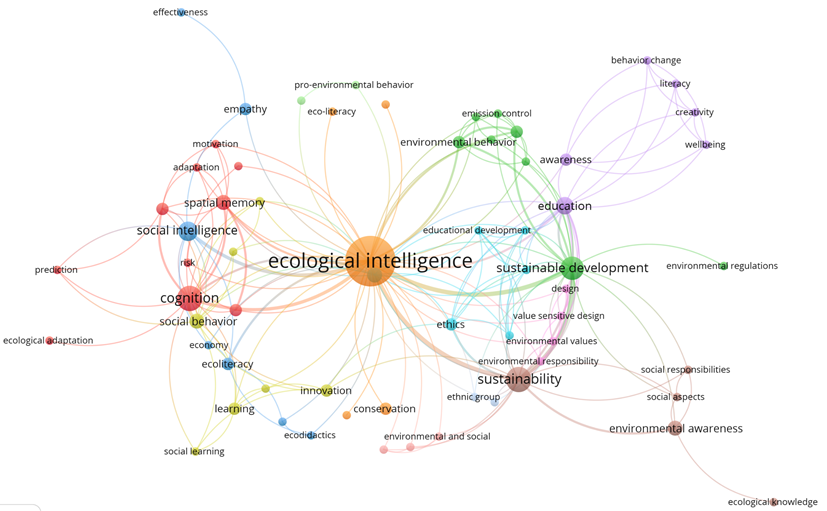
Note. Only cognitive–behavioral–affective and contextual terms were selected. Total Link Strength (TLS) represents the cumulative strength of a term’s co-occurrence links. Higher TLS values indicate greater centrality, meaning that the term plays a more influential role within the conceptual structure of the network. Link to the dynamic map: https://tinyurl.com/27hseezt
Fuente: Elaborada por los autores.
As shown in the co-occurrence map, the ecological intelligence dataset produced 65 analyzable terms after preprocessing. Table 1 summarizes their distribution across cognitive–behavioral–affective and contextual terms.
Table 1. Classification of terms included in the ecological intelligence dataset
|
Category |
Terms Included |
|
Cognitive–Behavioral–Affective |
adaptation; awareness; behavior change; cognition; creativity; decision making; decision-making; ecoliteracy; ecological adaptation; ecological intelligence; ecological knowledge; emission control; emission reduction; empathy; environmental awareness; environmental behavior; environmental responsibility; flexible planning; foraging behavior; foraging cognition; innovation; innovations; learning; memory (short-term); motivation; planning; prediction; pro-environmental behavior; rationalization; risk; social behavior; social intelligence; social learning; social responsibilities; spatial cognition; spatial memory; sustainable consumption; value-sensitive design; wellbeing.
|
|
Contextual |
assessment; conservation; eco-literacy; ecodidactics; ecological modeling; economy; ecopedagogy; education; educational development; effectiveness; engineering activities; environmental and social; environmental ethics; environmental regulations; environmental studies; environmental values; ethics; ethnic group; interdisciplinary approach; literacy; social aspects; sustainability; sustainable development; technologies. |
Fuente: Elaborada por los
autores.
Terms of Emotional Intelligence
This analysis generated a map of 60 items and 548 links, with a Total Link Strength of 1079 and 7 clusters (figure 2). The most central terms were emotional intelligence (occurrences = 61, links = 58, TLS = 240, Cluster 2), emotion (occurrences = 35, links = 48, TLS = 180, Cluster 4), emotions (occurrences = 32, links = 48, TLS = 175, Cluster 4), intelligence (occurrences = 23, links = 35, TLS = 111, Cluster 3), and psychological adaptation (occurrences = 10, links = 41, TLS = 85, Cluster 1).
These results highlight both the conceptual foundations (emotion, intelligence) and applied dimensions (psychological adaptation) of the construct.
Figure 2. Co-occurrence map of terms in the studies analyzed on “emotional intelligence”
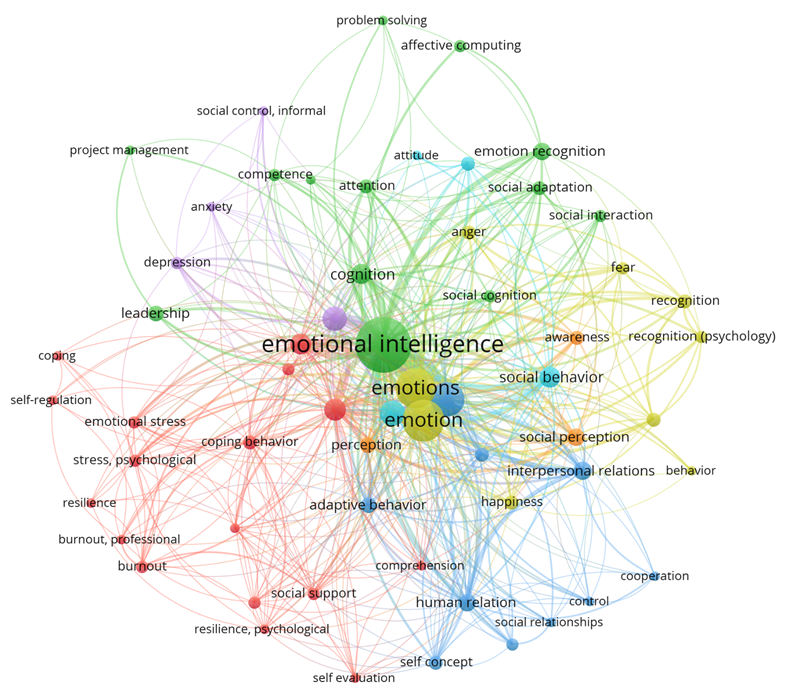
Note: Only cognitive–behavioral–affective and contextual terms were selected. Total Link Strength (TLS) represents the cumulative strength of a term’s co-occurrence links. Higher TLS values indicate greater centrality, meaning that the term plays a more influential role within the conceptual structure of the network. Link to the dynamic map: https://tinyurl.com/2ccnp2ot
Fuente: Elaborada por los autor.
As shown in the co-occurrence map, the emotional intelligence dataset produced 60 analyzable terms after preprocessing. Table 2 summarizes their distribution across cognitive–behavioral–affective and contextual terms.
Table 2. Classification of terms included in the emotional intelligence dataset
|
Category |
Terms Included |
|
|
Cognitive–Behavioral–Affective |
adaptation (psychological); adaptive behavior; affect; affective computing; anger; anxiety; attention; attitude; awareness; behavior; burnout; burnout (professional); cognition; competence; comprehension; control; cooperation; coping; coping behavior; decision making; depression; emotion; emotion recognition; emotion regulation; emotional disorder; emotional intelligence; emotional stress; emotions; empathy; facial expression; fear; happiness; human relation; intelligence; interpersonal relations; leadership; mindfulness; perception; personal satisfaction; problem solving; project management; recognition; recognition (psychology); resilience; resilience (psychological); self-concept; self-evaluation; self-regulation; social adaptation; social behavior; social cognition; social competence; social control (informal); social interaction; social perception; social relationships; social support; stress (psychological); well-being.
|
|
|
Contextual |
psychology |
|
Fuente: Elaborada por los autores.
Convergence of Terms
The comparative analysis revealed nine terms that explicitly converge between ecological and emotional intelligence: adaptability, awareness, behavior, decision-making, empathy, regulation, responsibility, social skills, and well-being (figure 3). These findings emphasize a common conceptual foundation centered on awareness, self-regulation, responsible action, and social competencies, all oriented toward well-being and adaptive responses to environmental challenges.
Figure 3. Intersecting terms of ecological and emotional intelligence
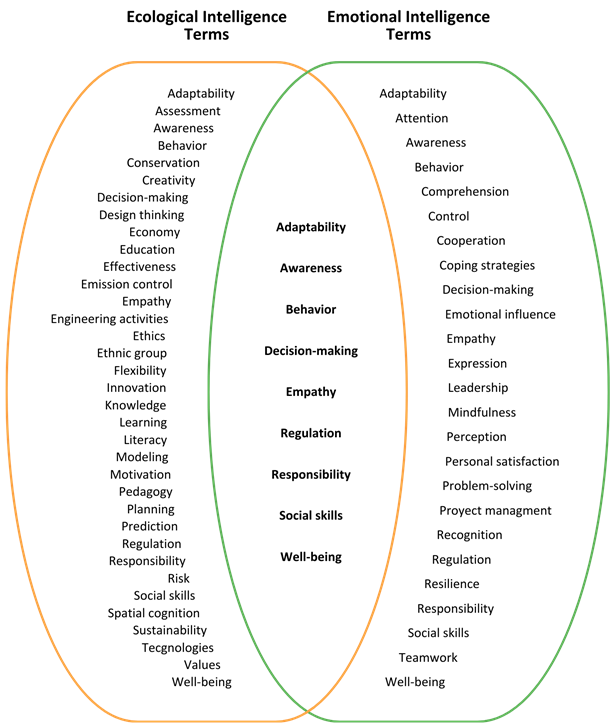
Note: Terms representing equivalent concepts were unified through minimal lexical normalization rules, including singular–plural merging, integration of close morphological variants, and consolidation of evident semantic equivalents documented in the literature.
Fuente: Elaborada por los
autores.
DISCUSSION
The results obtained reinforce the hypothesis that ecological intelligence and emotional intelligence, although traditionally studied separately, share a common conceptual basis. The explicit convergence in terms such as awareness, empathy, regulation, social skills, and well-being confirms that emotional management and environmental awareness are not independent processes; they form part of an interrelated system that influences how individuals relate to their environment. These findings align with earlier proposals that emphasize the interdependence between emotional processes and environmental engagement (Goleman, 2009; Salovey & Mayer, 1990; Goleman et al., 2012), as well as with structural models of emotional competencies (Bar-On, 1997; Bisquerra, 2020).
Recent research further supports this relationship. Studies show that emotional intelligence predicts pro-environmental behavior through mediating variables such as empathy, perception of climate impacts, and sustainability-related values (Lisboa et al., 2024; Marchetti et al., 2024; Rada et al., 2025; Ballarotto et al., 2025). In parallel, research on environmental emotions has documented how climate worry, hope, pride, and guilt influence decision-making and engagement in sustainability-oriented behaviors (Clayton & Ogunbode, 2023; Schneider et al., 2021; Zelenski & Desrochers, 2021; Shipley & Van Riper, 2022). Large-scale studies have also shown that climate anxiety is associated with both pro-environmental action and reduced psychological well-being (Ogunbode et al., 2022; Ojala et al., 2021), while recent work has validated instruments for measuring eco-emotions such as eco-guilt, ecological grief, and eco-anxiety (Zeier & Wessa, 2024).
Educational research also highlights the role of socioemotional competencies in fostering environmental responsibility, suggesting that ecological awareness is strengthened when emotional dimensions are incorporated into instructional design (Goleman et al., 2012) and when environmental care is taught as an integral component of quality education for sustainable development (López-Machín, 2025; United Nations, 2025). Approaches that combine ecoliteracy, emotional regulation, and collaborative skills appear especially promising for promoting sustainable behaviors and resilience in the face of climate-related stressors. Taken together, these findings reinforce the view that socioemotional and ecological competencies should not be addressed as isolated domains.
At a theoretical level, the identified convergence offers evidence for an integrated framework in which emotional intelligence processes—such as empathy, regulation, and social responsibility—support environmentally responsible decision-making. This integration may clarify mechanisms through which socioemotional skills influence sustainability-related behaviors and attitudes and may help to situate ecological intelligence within broader models of psychological adaptation and well-being (Bar-On, 1997; Goleman et al., 2012).
Practically, the results suggest that environmental education programs could be strengthened by incorporating socioemotional competencies, especially emotional regulation, empathy, and collaborative skills. Educational policies seeking to promote sustainability may therefore benefit from explicitly linking emotional and ecological competencies and from integrating the assessment of eco-emotions such as eco-anxiety, guilt, and grief (Ojala et al., 2021; Zeier & Wessa, 2024).
As noted in the methodological section, several additional limitations must be acknowledged. First, the analysis relied exclusively on Scopus, which may exclude relevant studies indexed in other databases or published in non-English contexts. Second, the selection of the 100 most cited publications on emotional intelligence, although justified by bibliometric standards, may underrepresent emerging findings and privilege older foundational literature. Third, co-occurrence analyses capture explicit terminology but may overlook implicit conceptual terms such as ethics, communication, values, or resilience, which are present in theoretical models but not always reflected in indexed terms.
Although explicit convergences emerged from the bibliometric analysis, several theoretically relevant constructs did not appear among the indexed terms. Foundational literature on emotional intelligence and ecological intelligence shows that both domains incorporate constructs such as communication (Bisquerra, 2020; Goleman, 1995; Salovey & Mayer, 1990), ethics and responsibility (Bisquerra, 2020; McCallum, 2005; Sterling, 2009), attitudes, norms, and values (Corral-Verdugo, 2021; Bisquerra, 2020), resilience (Orr, 1994; Goleman, 1995; Bar-On, 1997), motivation (Antonopoulou, 2024; Brick et al., 2021), and teamwork and collaboration (Bisquerra, 2020; Goleman, 1995). Their absence in the co-occurrence maps reflects a limitation of relying exclusively on indexed terms, as many conceptual dimensions remain implicit in theoretical models and empirical work.
Finally, the lack of a consolidated, multidimensional model for ecological intelligence limits the depth of the comparison, especially when contrasted with more developed frameworks of emotional intelligence and eco-emotions (Bar-On, 1997; Goleman et al., 2012; Zeier & Wessa, 2024).
Future studies should incorporate multi-database searches and include emerging literature on climate emotions, sustainability competencies, and environmental decision-making (Clayton & Ogunbode, 2023; Ogunbode et al., 2022). Empirical work is also needed to test the convergent components identified here, for example through scale development, mixed methods designs, or intervention studies in educational and organizational contexts. Longitudinal analyses could examine how emotional and ecological competencies interact over time, while experimental research may clarify causal mechanisms linking emotional intelligence to environmental behavior. Developing a validated, multidimensional framework for ecological intelligence remains a particularly urgent line of inquiry.
In accordance with the journal’s editorial guidelines, priority was given to literature published during the last five years when interpreting the findings. Earlier works were retained only when they represent either foundational theoretical contributions to the constructs of ecological intelligence and emotional intelligence or essential methodological references widely recognized in bibliometric research. This approach allowed the study to balance the incorporation of recent scientific advances with the preservation of key theoretical and methodological references that structure the field.
CONCLUSIONS
In relation to the objective of analyzing the conceptual convergence between ecological intelligence and emotional intelligence, the findings of this study confirm a clear overlap around key terms such as awareness, decision-making, empathy, regulation, and well-being. This convergence indicates that both constructs share a common foundation structured through cognitive–behavioral–affective terms.
At the same time, the results highlight important asymmetries between the fields. Ecological intelligence lacks a consolidated theoretical model with defined dimensions and indicators, whereas emotional intelligence benefits from more established frameworks and validated measurement tools. This difference limits the depth of direct comparisons and clarifies the current boundaries of conceptual integration.
Overall, the evidence shows that emotional and ecological domains intersect in ways that may be relevant for research on human–environment interactions. A clearer systematization of ecological intelligence would allow more robust comparative analyses and a more precise understanding of its relationship with emotional processes. Strengthening this conceptual groundwork will be essential for future studies seeking to examine how both forms of intelligence operate within contemporary environmental and social contexts.
BIBLIOGRAPHIC REFERENCES
Antonopoulou, H. (2024). The value of emotional intelligence: Self-awareness, self-regulation, motivation, and empathy as key components. Technium Education and Humanities, 8, 78-92. https://doi.org/10.47577/teh.v8i.9719
Ballarotto, G., Volpi, B., Chiarotti, F., & Giannini, M. (2025). Feeling the nature to foster sustainability: The mediating role of empathy and compassion. Sustainability, 17(1), 351. https://doi.org/10.3390/su17010351
Bar-On, R. (1997). The Emotional Intelligence Inventory (EQ-i): Technical manual. Multi-Health Systems.
Beck, J. S. (2021). Cognitive
behavior therapy: Basics and beyond (3rd ed.). The Guilford Press.
Bisquerra, R. (2020). Educación emocional. Red Internacional de Educación Emocional y Bienestar. https://www.rafaelbisquerra.com/educacion-emocional
Brick, C., Bosshard, A., & Whitmarsh, L. (2021). Motivation and climate change: A review. Current Opinion in Psychology, 42, 82-88. https://doi.org/10.1016/j.copsyc.2021.04.001
Clayton, S., & Ogunbode, C. (2023). Looking at emotions to understand responses to environmental challenges. Emotion Review, 15(4), 255–262. https://doi.org/10.1177/17540739231193757
Corral-Verdugo, V. (2021). Psychology of climate change. PsyEcology, 12(2), 254-282. https://doi.org/10.1080/21711976.2021.1901188
De Solla, D. J. (1976). A general theory of bibliometric and other cumulative advantage processes. Journal of the American Society for Information Science, 27(5), 292-306. https://doi.org/10.1002/asi.4630270505
Donthu, N., Kumar, S., Mukherjee, D., Pandey, N., & Lim, W. M. (2021). How to conduct a bibliometric analysis: An overview and guidelines. Journal of Business Research, 133, 285-296. https://doi.org/10.1016/j.jbusres.2021.04.070
Dryden, W. (2021). Rational emotive behaviour therapy: A new primer. Routledge.
Fernández-Dávila, M. J. (2023). La inteligencia ecológica como alternativa frente a la crisis ambiental. Apuntes de Bioética, 6(1), 60-72. https://doi.org/10.35383/apuntes.v6i1.797
Firth, J. R. (1957). A synopsis of linguistic theory 1930–1955. In J. R. Firth, Studies in linguistic analysis (pp. 1–32). Blackwell.
Garfield, E. (1972). Citation analysis as a tool in journal evaluation. Science, 178(4060), 471-479. https://doi.org/10.1126/science.178.4060.471
Goleman, D. (1995). Emotional intelligence. Bantam Books.
Goleman, D. (2009). Ecological intelligence: How knowing the hidden impacts of what we buy can change everything. Broadway Books.
Goleman, D., Bennett, L., & Barlow, Z. (2012). Ecoliterate: How educators are cultivating emotional, social, and ecological intelligence. John Wiley & Sons.
Lisboa, P. V.,
Gómez-Román, C., Gutín, L., & Monteiro, A. P. (2024). Pro-environmental
behavior, personality and emotional intelligence in adolescents: a systematic
review. Frontiers in Psychology, 15, 1323098. https://doi.org/10.3389/fpsyg.2024.1323098
López-Machín, C. E. (2025). Emociones y educación de
calidad: Repensando el ODS 4 desde la experiencia humana del aprendizaje. Prisma
ODS: Revista Multidisciplinaria sobre Desarrollo Sostenible, 4(2), 92-106. https://doi.org/10.65011/prismaods.v4.i2.73
Lovelock, J. E. (1979). Gaia: A new look at life on Earth. Oxford University Press.
Marchetti, V., Panno, A., Scopelliti, M., Romano, L., Angelini, G., Rinallo, E., Barni, D., & Fiorilli, C. (2024). Trait emotional intelligence and ecological outcomes: The role of connectedness to nature. BMC Psychology, 12, Article 201. https://doi.org/10.1186/s40359-024-01679-9
McCallum, I. (2005). Ecological intelligence: Rediscovering ourselves in nature. Africa Geographic.
Ogunbode, C. A., Doran, R., Hanss, D., Ojala, M., Salmela-Aro, K., van den Broek, K. L., Bhullar, N., Aquino, S. D., Marot, T., Aitken Schermer, J., Wlodarczyk, A., Lu, S., Jiang, F., Acquadro Maran, D., Yadav, R., Ardi, R., Chegeni, R., Ghanbarian, E., Zand, S., Najafi, R., … Karasu, M. (2022). Climate anxiety, wellbeing and pro-environmental action: Correlates of negative emotional responses to climate change in 32 countries. Journal of Environmental Psychology, 84, 101887. https://doi.org/10.1016/j.jenvp.2022.101887
Ojala, M., Cunsolo, A., Ogunbode, C. A., & Middleton, J. (2021). Anxiety, worry, and grief in a time of environmental and climate crisis: A narrative review. Annual Review of Environment and Resources, 46, 35-58. https://doi.org/10.1146/annurev-environ-012220-022716
Orr, D. (1994). Environmental
literacy: Education as if the Earth mattered. Human Scale Education.
Pérez-Frausto, E., & Torres-Cantú, R. (2024). El cuidado del medio
ambiente como práctica para la gestión de emociones. Revista Investigium IRE: Ciencias Sociales y Humanas, 15(2),
19-36. https://doi.org/10.15658/INVESTIGIUMIRE.241502.02
Pérez-Frómeta, R., Márquez Lores, H., & Piclín
Minot, J. (2023). Reflexiones teóricas sobre la formación de actitudes
ambientales en la primera infancia. EduSol, 23(84). http://scielo.sld.cu/scielo.php?script=sci_arttext&pid=S1729-80912023000300111
Rada, E. T., Balila, E., & Segovia, A. (2025). Role of emotional intelligence in sustainability behavior: A structural equation modeling approach. Bedan Research Journal, 10(1), 29-52. https://doi.org/10.58870/berj.v10i1.79
Salovey, P., & Mayer, J. D. (1990). Emotional intelligence. Imagination, Cognition and Personality, 9(3), 185-211. https://doi.org/10.2190/DUGG-P24E-52WK-6CDG
Schneider, C. R., Zaval, L., & Markowitz, E. M. (2021). Positive emotions and climate change. Current Opinion in Behavioral Sciences, 42, 114-120. https://doi.org/10.1016/j.cobeha.2021.04.009
Schvaneveldt, R. W. (1990). Pathfinder associative networks: Linking cognitive science and education. Ablex Publishing Corporation.
Shipley, N. J., & Van Riper, C. J. (2022). Pride and guilt predict pro-environmental behavior: A meta-analysis of correlational and experimental evidence. Journal of Environmental Psychology, 79, e101753. https://doi.org/10.1016/j.jenvp.2021.101753
Shiva, V. (2005). Earth democracy: Justice, sustainability, and peace. South End Press.
Small, H. (1973). Co‐citation in the scientific literature: A new measure of the relationship between two documents. Journal of the American Society for Information Science, 24(4), 265–269. https://doi.org/10.1002/asi.4630240406
Sterling, S. (2009). Towards ecological intelligence. In A. Stibbe (Ed.), The handbook of sustainability literacy: Skills for a changing world (pp. 77–83). Green Books.
United Nations. (2025.). Quality education. https://www.un.org/sustainabledevelopment/education
Van Eck, N. J., & Waltman, L. (2010). Software survey: VOSviewer, a computer program for bibliometric mapping. Scientometrics, 84, 523-538. https://doi.org/10.1007/s11192-009-0146-3
Zeier, P., & Wessa, M. (2024). Measuring eco-emotions: a German version of questionnaires on eco-guilt, ecological grief, and eco-anxiety. Discover Sustainability, 5(29). https://doi.org/10.1007/s43621-024-00209-2
Zelenski, J. M., & Desrochers, J. E. (2021). Can positive and self-transcendent emotions promote pro-environmental behavior? Current Opinion in Psychology, 42, 31-35. https://doi.org/10.1016/j.copsyc.2021.02.009
Anexo 1. Operational codebook used for the semantic classification of co-occurrence terms
|
Category |
Operational definition |
Example terms from the dataset |
Prototypical examples from source dataset |
||||
|
Cognitive–Behavioral–Affective Terms |
Terms referring to integrated psychological processes involving cognition (associated with knowledge, understanding, perception, appraisal, and decision-making), behavior (referring to practices, habits, observable actions, and competencies of interaction or environmental engagement), and affect (related to emotions, attitudes, values, motivations, and socioemotional dispositions). |
awareness, empathy, learning, decision-making, motivation, emotion regulation, social learning, environmental behavior, resilience |
Ecological intelligence corpus: “Environmental awareness, attitude towards recycling, convenience, ecological intelligence, and norms & publicity were primary factors affecting women’s e-waste recycling behavioral intentions.”
Emotional intelligence corpus: “Emotional intelligence refers to the individual differences in the perception, processing, regulation, and utilization of emotional information.”
|
|
|||
|
Contextual Terms |
Terms referring to thematic, disciplinary, institutional, or environmental contexts surrounding the constructs rather than psychological processes themselves. |
sustainability, ecopedagogy, education, environmental ethics, conservation, psychology
|
Ecological intelligence corpus: “The article presents a review of the literature on environmental education with particular reference to the notions of eco-literacy, ecological intelligence, and ecopedagogy.”
Emotional intelligence corpus: “Social and emotional learning programs improved students’ social and emotional skills and academic performance.”
|
|
|||